
 Contact us
Sep 2, 2026•5 min read
How Metal Price Volatility Is Reshaping Office Fit-Out Costs in India
Read More
Written by: Aaradhna
Published at: 07/27/26
If you are stepping out in to the market to lease an office, chances are that two kinds of proposals land on your desk. One quotes a rent per square foot; the other quotes an all-in number per seat. So when it comes to making an apples-to-apples decision, you need to quickly figure out the gap between them and what to decide.
India's office market entered 2026 in expansion mode, with a record high leasing recorded. According to Altre's India Office Leasing Landscape Q1 2026, the country recorded 19.2 million sq ft of gross office leasing in the first quarter alone, an 18% jump over the same period a year earlier, with average rentals climbing to roughly INR 110 per sq ft per month, up 9% year-on-year. By nearly all readings, that's a healthy, occupier-confident market.
Let's take a closer look at who is doing the leasing though. Co-working and managed operators contributed 25% of total leasing demand in Q1 2026, second only to IT/ITeS at 29% and ahead of BFSI at 16%. A full quarter of the office space India absorbed in three months was taken by operators packaging that space into a managed product. In Pune, managed operators accounted for 52% of all leasing, the highest share of any Indian city, reflecting its pull for mid-market firms and GCC scale-up operations.
Looking at the entire first half of this calendar year, and co-working sector as a whole took 20% of the country's 39.8 million sq ft of gross leasing, second only behind the IT and enabled services sector. And a good proportion of this leasing activity is driven because of the rising demand for coworking and managed spaces, not just from startups and hybrid operational companies, but MNCs, GCCs, and enterprises as a whole.
For anyone setting up or scaling a Global Capability Centre in India, the question has shifted to which model fits the operating reality of a company, and what does the total cost picture actually look like once every line item is on the table?
Most of the confusion in this debate comes from treating the two products as variations of the same thing. They aren't. Before any cost comparison can run, each has to be defined honestly.
A conventional lease in India is a warm shell. The landlord delivers a bare floor: basic flooring, HVAC ducting, fire-safety provisions, and power points. Every layer that turns that shell into a working office is the tenant's responsibility: the fit-out, the furniture, the IT cabling, the workstations, the meeting rooms, the pantry, the access control, the DG backup, the housekeeping vendor, the security contract, the facility manager on payroll, the IT support, the AMCs, the internet line, the utility connections. Depending on your negotiations and previous condition of the office, you might get a furnished office with fresh fit-out or a as-is basis lease in certain cases.
The headline rent, INR 100, INR 120, INR 180 per sq ft, covers the shell. Furnished and as-is rentals are higher of course, and everything else is layered on top by the tenant as CAPEX.
A managed office is the inverse. The operator delivers a fully built, branded, furnished, IT-enabled, operational workspace under a single monthly fee. Rent, fit-out amortisation, furniture, IT, utilities, internet, housekeeping, security, facility management, pantry, DG backup: all consolidated into one invoice, bundled as a per-seat cost with the CAPEX amortized over the tenure of the lease. The tenant signs, moves in, and operates.
What's included versus what's the tenant's problem is the only useful starting point for a cost comparison. A per-seat number and a per-sq-ft number simply don't describe the same object. You aren't comparing two prices for the same thing. You're comparing the cost of a shell against the cost of a finished, operational office.
When it comes to the comparison, question that needs to be answered is what it costs to bridge the gap between a shell and furnished space.
Translating that gap on the balance sheet, the divergence is in when, and how, you spend money.
On a conventional deal, you take the shell from the landlord at, say, INR 100 per sq ft plus CAM, and then you invest your own capital into the build: design, fit-out, furniture, IT. That capex is a large upfront cost, and it stays blocked. You're also taking on the entire project: designing the space, finding and managing contractors, and running operations once it's live. If you have internal teams who can execute all of that, and you're committing for the long term, the economics can work strongly in your favour. You own the asset and can claim depreciation against it.
A managed deal shifts that cost. The operator carries the build and the management, and you use the space as a plug-and-play model (a ready-to-use system). The capex doesn't hit you upfront: it's amortised, typically over three or five years, often paired with a matching lock-in. Your capital isn't trapped in fit-out; it stays free to deploy into operations, hiring, and the actual business. You also keep the option to expand with the same operator in the same building as you scale, without renegotiating from scratch.
The managed price is the warm shell, plus CAM, plus amortised capex, plus operating costs, plus the operator's margin. It carries a premium per seat, but that premium is buying two things a spreadsheet often misses: the release of blocked capital, and the removal of an entire operational function from your plate.
The flexibility of a managed deal extends all the way into how the price is structured for you. A managed arrangement isn't a fixed menu; much of it is negotiable around how your business wants to consume the space, and that includes the basis on which you're billed.
Take the way seats are priced. Operators often bill per seat, which sounds clean and headcount-friendly. But a billable seat isn't necessarily the desk a person sits at. It can be priced on the area occupied per person, with a loaded share of common space (reception, corridors, meeting rooms, pantry, break-out zones) built into each seat. That means the number of billable seats can come out different from your actual headcount, depending on how much common area is loaded in.
This isn't a fixed catch you simply have to absorb: it's a lever in how the deal is structured for you. You might want a tighter loading so the per-seat number tracks headcount closely, or you might prefer a per-sq-ft basis altogether. Two operators can quote what looks like the same per-seat rate and land at very different total costs, simply because one loads more common area into each seat than the other.
So key questions during the proposal stage become “what carpet area, and what common-area loading, sits behind each billable seat, and can we structure it differently?” From there it's easier to normalise everything back to cost per usable square foot, and the comparison becomes simpler.
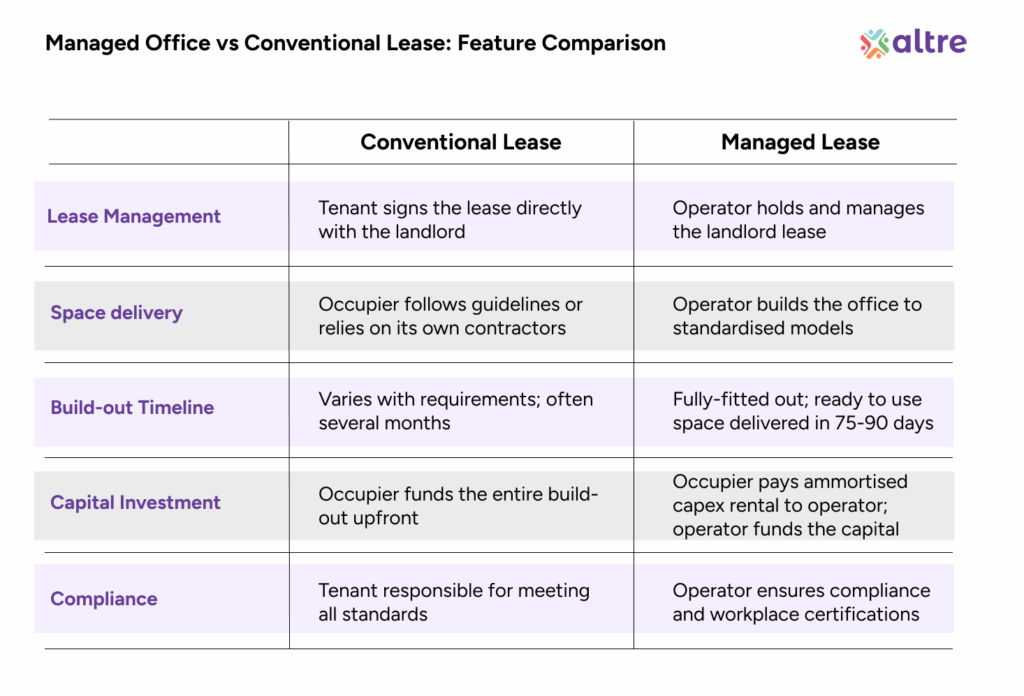
Broad strokes and the commercial real estate market rarely go hand in hand. But to keep it simple, we'll talk in broad terms here. A conventional lease rewards scale and tenure. At a long horizon, with in-house teams to design and run the space, it delivers the lowest cost per seat even when accounting for CAPEX and OPEX, full control over design and build quality, an owned fit-out asset you can depreciate, and no operator margin on top. The trade-offs: heavy capex blocked upfront, a long buildout you have to manage, the full weight of operations on your team, rigidity when you need to scale, and exposure to every unforeseen risk.
A managed office rewards speed and agility. It's plug-and-play, live in under four months, with capital staying free for the business rather than trapped in fit-out, capex amortised flexibly over three to five years, the ability to scale and relocate seats with a single operator, and operations, compliance, and ESG handled for you. The costs are a higher premium per seat over a raw lease, less control over design, lock-ins that still apply, and no owned asset at the end.
The answer is capital, control, and time horizon. Conventional works if you have a long horizon, maybe internal teams to design and run the space, capital to invest upfront, and want total control plus the lowest cost-per-seat at scale. Managed works if you're standing up or scaling quickly, want capital free for the business rather than locked in fit-out, value the flexibility to flex and relocate, and would rather an operator carry operations, compliance, and risk.
The city matters too. Managed office supply varies significantly across India's top markets: Bengaluru's ORR and Whitefield, Hyderabad's HITEC City and Financial District, and Gurugram's Golf Course Extension Road each have different supply depth, pricing ranges, and floor plate availability. For GCCs weighing city alongside format, Altre's Business Location Advisory platform covers both dimensions together.
The process is the same in either case: normalise both proposals to cost per usable square foot, and per actual head, before deciding. The premium on a managed seat is often the price of freed capital and removed operational load. Judge it on that basis, not on the sticker.
Managed operators are now a fifth of national leasing demand, and a majority in cities like Pune. The model has moved from startup convenience to mainstream corporate strategy. The decision is no longer about company type. It's about which cost structure fits how your GCC actually intends to operate and grow.
Is a managed office cheaper than a conventional lease in India?
It depends on the time horizon. In Year 1, a managed office is typically cheaper in net terms because the large capex of a conventional fitout hits immediately while it is amortised over three to five years on a managed deal. By Year 4 or Year 5, the conventional lease's lower monthly rent often brings its cumulative cost below the managed option. The crossover point depends on fitout cost, CAM charges, facility management overhead, and headcount. The right comparison is total cost of occupancy across the lease term, not per-seat sticker price.
What is included in a managed office fee in India?
A managed office monthly fee typically covers rent, fitout amortisation, furniture, IT infrastructure, internet, utilities, housekeeping, security, facility management, pantry, and DG backup, all in a single invoice. What is not included varies by operator and needs to be clarified upfront: customisation beyond standard fit, dedicated server rooms, specialised IT configurations, and branded signage are often excluded or priced separately.
What is the average managed office cost per seat in India in 2026?
Managed office pricing in Grade-A buildings across India's top cities ranges from INR 10,000 to INR 25,000 per seat per month, varying by city, floor size, common area loading, and configuration. Hyderabad and Pune tend to offer the most competitive per-seat pricing. Bengaluru commands a premium on ORR and Whitefield. Mumbai's BKC is the most expensive market. These figures should be normalised to cost per usable square foot for an accurate comparison with conventional lease rates.
How long does a managed office take to set up vs a conventional office in India?
A managed office is typically operational within four to eight weeks of signing. A conventional office fitout in India, from lease signing through design, contractor engagement, build, and IT installation, runs four to six months at minimum for a mid-sized GCC setup. Speed-to-occupancy is one of the clearest structural advantages of the managed model.
What is the security deposit for a managed office vs a conventional lease in India?
Conventional leases in India typically require a security deposit of six to ten months'rent, representing significant locked capital on top of the fitout investment. Managed office deposits are typically two to three months, and some operators offer zero-deposit structures for enterprise clients with strong credit profiles.
When does a conventional lease become cheaper than a managed office in India?
Typically between Year 3 and Year 5, depending on market, fitout cost, and headcount. Below that horizon, the capex front-loading of a conventional deal usually keeps its cumulative cost above managed. Beyond it, the managed office's per-seat premium compounds and the conventional lease's lower monthly cost begins to dominate. For GCCs with a confirmed five-plus year horizon and internal real estate capability, conventional leasing is often the lower-cost model at scale.
Published: July 27, 2026
Discover more insights and expert perspectives on commercial real estate and business growth



Copyright © 2026. All rights reserved.