
 Contact us
Oct 9, 2026•5 min read
India's Position in the Global BFSI Office Market: GCCs, Growth and Outlook
Read More
Written by: Vidushi Kajla
Published at: 09/02/26
India's office market is witnessing one of its strongest years on record. Pan-India office leasing crossed nearly 40 million sq. ft. in H1 2026, with Global Capability Centres (GCCs) accounting for almost half of the demand. Every leased office eventually progresses to the fit-out stage, where designing and delivering a functional workplace makes office fit-out costs critical.
Every commercial fit-out relies on materials such as copper, aluminium, steel and zinc. Over the past year, these office fit-out materials have experienced uneven price growth driven by global supply chain disruptions, geopolitical tensions and rising demand from renewable energy and data centres.
Although all of these materials have become more expensive, they have not followed the same trajectory. Copper continues to benefit from long-term structural demand, Aluminium has been shaped largely by supply-side disruptions, while Steel has remained comparatively resilient due to India's strong domestic manufacturing base. Understanding these differences is becoming essential for developers, occupiers and contractors, as each material affects a different component of an office fit-out, influences procurement risk and ultimately shapes overall office fit-out costs.
Each metal serves a different purpose within an office fit-out and is influenced by distinct supply and demand dynamics. The figures below present approximate year-on-year price growth as of mid-2026 and are intended to illustrate the relative movement across key materials, rather than represent fixed market prices. Understanding the role of each material helps developers, occupiers and contractors identify where procurement risks are highest and which cost components are most exposed to global market volatility.
| Material | Typical Office Applications | Key Driver | Impact on Office Fit-outs |
| Copper | Electrical wiring, structured cabling, fire alarm systems, earthing, HVAC piping | Global supply tightness, US stockpiling, data centre and power grid demand | Higher electrical and MEP package costs |
| Aluminium | Glass partitions, curtain walls, ceiling grids, window & door frames, raised flooring | Production cap, West Asia supply disruptions, low inventories | Increased partition, glazing and façade costs |
| Structural Steel | Structural framing, staircases, mezzanines, reinforcement | Safeguard duties, strong domestic infrastructure demand | Firmer but relatively predictable structural costs |
| GI Steel | Partition framing, false ceiling channels, HVAC ductwork, cable trays | Steel base price plus a separate zinc coating premium | Moderate cost increase with added exposure to zinc price volatility |
| Stainless Steel | Handrails, reception counters, lift lobbies, decorative finishes | Nickel price swings, Asian oversupply | Premium finishes experience occasional cost spikes |
| Zinc | Galvanising, door hardware, switch plates, plumbing fittings | Mine supply deficit, record-low treatment charges | Sharply higher hardware, fittings and galvanising costs |
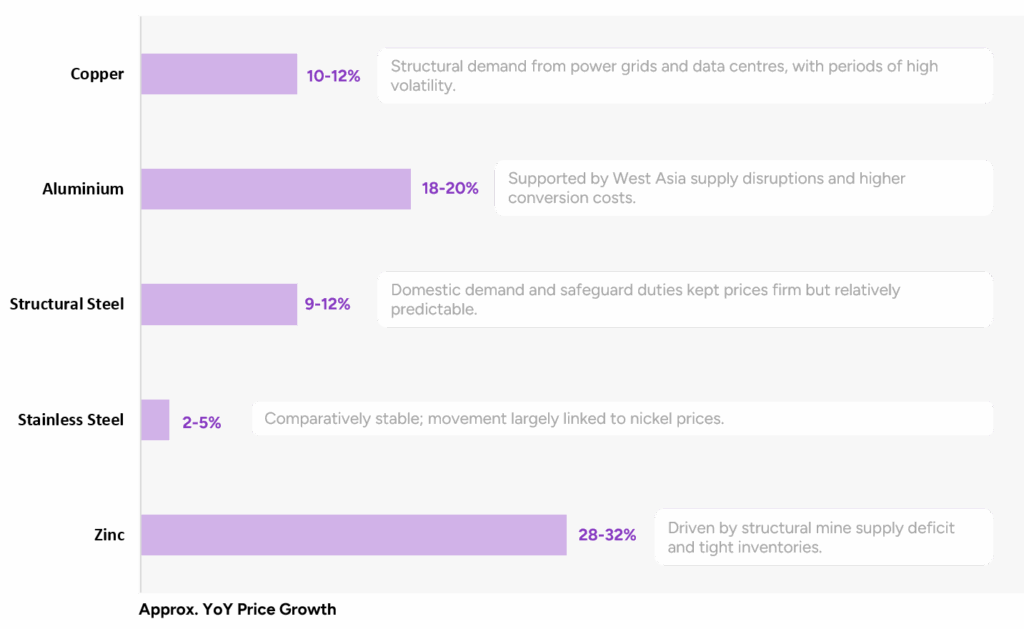
Copper remains one of the key cost pressures for office fit-outs, not just because of recent price movements but because of the strong demand expected over the coming years. The expansion of renewable energy, EVs, power networks and data centres is increasing the need for copper across the global economy.
For office projects, the impact is particularly relevant as copper is extensively used in electrical, cabling and MEP works. This makes it difficult to avoid higher copper costs, especially in large projects with significant electrical and building-services requirements.
Unlike copper, which has seen prices rise mainly on the back of strong long-term demand, aluminium prices have been more affected by supply constraints and disruptions. Aluminium is used extensively across modern office spaces — from glass partitions and window frames to façades and ceiling systems. This means even a moderate increase in aluminium prices can add to fit-out costs, particularly in offices that use a lot of glass and lightweight framing.
Unlike copper and aluminium, whose recent price movements have been driven largely by global supply chain disruptions and structural demand, steel has remained comparatively stable. India's strong domestic manufacturing base, supportive trade policies and sustained infrastructure investment have created a more predictable pricing environment, making steel one of the most reliable office fit-out materials for commercial projects. While costs have increased gradually, steel has offered greater budgeting certainty than most other materials used in office construction.
Among the key materials used in office fit-outs, zinc has seen the biggest jump in prices over the past year. It may not get the same attention as copper, aluminium or steel, but it quietly finds its way into a wide range of fit-out components, from galvanised products and hardware to finishing elements.
The turnaround has been quite sharp. Zinc was actually the weakest-performing major base metal in 2025, but tighter mine supply, lower refinery output and falling inventories have since pushed prices up. For office projects, this means zinc is becoming a more noticeable cost pressure—despite being one of the less visible materials in a typical fit-out.
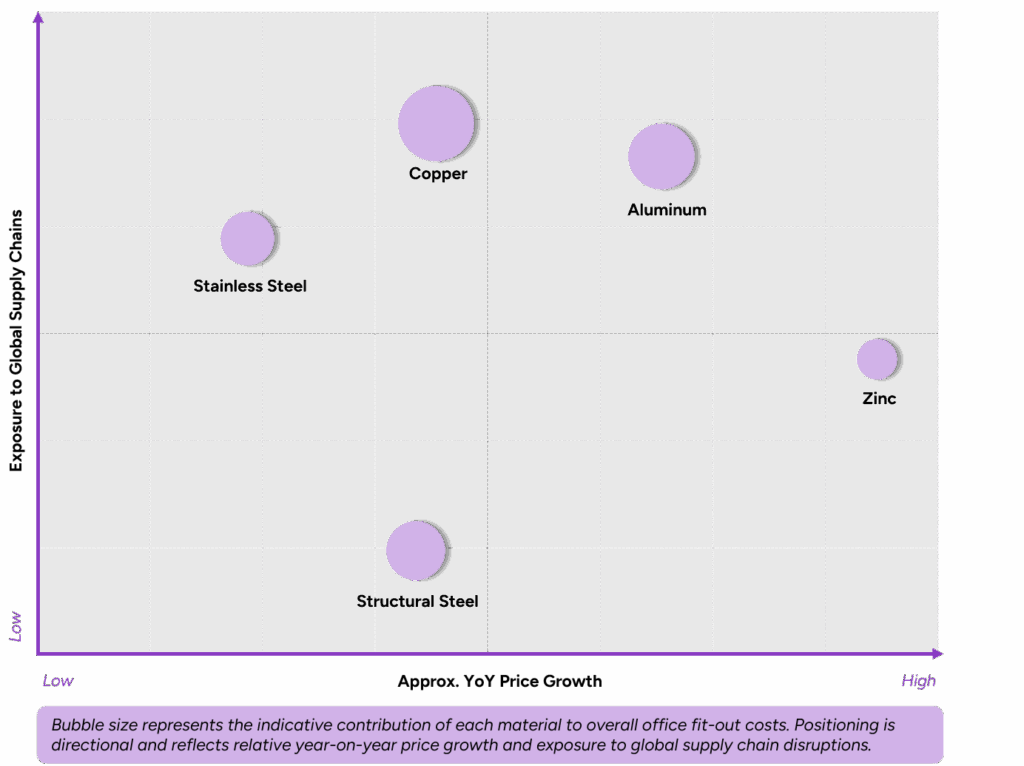
The year-on-year movements across these metals are not isolated events. They reflect a broader shift in the global operating environment, where geopolitical tensions, evolving trade policies and supply chain disruptions are becoming long-term drivers of office fit-out costs.
Despite these global headwinds, India's office market has remained resilient. Pan-India office leasing continues to be supported by strong occupier demand, particularly from Global Capability Centres (GCCs), while improved economic sentiment and continued investment have sustained demand for commercial office developments. This has ensured that demand for office fit-out projects has remained robust despite rising construction costs.
Where the application allows, uPVC and composite profiles are being considered as alternatives to aluminium for some internal partition systems. Aluminium still makes more sense for premium office spaces where the look, durability and long-term performance justify the higher cost.
Open-plan layouts naturally use fewer partitions and less framing, which can reduce the amount of aluminium and steel required. For larger office projects, even a small reduction in material use can translate into meaningful cost savings.
With material prices moving more frequently, project teams are finalising specifications and negotiating prices earlier. This is particularly useful for galvanised products and hardware, where the impact of rising zinc prices may not be obvious until supplier quotes start coming in.
Contractors and manufacturers are also looking at more suppliers and sourcing locally where possible. Using recycled materials, where specifications allow, can also help. A wider supplier base gives projects more flexibility and reduces the risk of being affected by a disruption in one market.
The rise in fit-out costs is not being driven by one factor alone. Commodity prices, global demand, geopolitical tensions, trade policies and supply chain disruptions are all feeding into project costs.
For developers, occupiers and contractors, trying to predict where every commodity price will move is probably not the most practical approach. The better strategy is to reduce exposure wherever possible — lock in important materials early, keep multiple suppliers available, review specifications carefully and keep a close watch on material prices. These steps can help keep budgets under control while also reducing the risk of project delays.
Copper is generally one of the biggest contributors to office fit-out costs because it is used extensively in electrical wiring, cabling, HVAC systems and fire-safety infrastructure. Its importance becomes even more pronounced in projects with high electrical and MEP requirements.
There is no single reason. Higher metal prices, supply chain disruptions, geopolitical tensions and strong demand for office space are all adding to fit-out costs. Together, these factors are making materials more expensive and making it harder for project teams to predict final procurement costs.
Copper and aluminium are among the most globally exposed materials. Copper is closely linked to worldwide demand from electrification, renewable energy and data centres, while aluminium has been affected by geopolitical tensions, shipping disruptions and energy-related constraints. Structural steel is relatively less exposed because India has a large domestic production base.
The impact goes beyond the material bill. A sudden increase in metal prices can push up the project budget, while supply disruptions can affect timelines. Delays in sourcing items such as aluminium profiles, galvanised products or electrical materials can hold up work on site. This is why early procurement and having multiple suppliers are becoming increasingly important.
Zinc is easy to overlook because it is usually part of other products rather than something bought separately. It is used in galvanised steel, cable trays, hardware, plumbing fittings and fasteners. So, even when zinc itself isn't visible in an office, a rise in its price can still show up in supplier quotes across several categories.
There are several ways to manage costs. Finalising specifications early, getting supplier quotes sooner, keeping multiple suppliers in the mix and reducing unnecessary material use can all help. Where the application allows, alternative materials can also be considered without compromising performance.
Structural steel currently carries relatively lower procurement risk compared with copper, aluminium and zinc. India's strong domestic steel manufacturing base and large production capacity provide greater supply security and make the market less dependent on international supply chains.
Material costs can change between the time a project is planned and when procurement actually happens. Keeping an eye on key metal prices gives occupiers and project teams more room to plan, negotiate and lock in important materials early. This can help avoid unexpected cost increases later in the project.
Published: September 2, 2026
Discover more insights and expert perspectives on commercial real estate and business growth

Copyright © 2026. All rights reserved.