Contact us
Sep 2, 2026•5 min read
How Metal Price Volatility Is Reshaping Office Fit-Out Costs in India
Read More
Written by: Aaradhna
Published at: 06/11/26
India's Global Capability Centre market is at an inflection point. With over 1,800 GCCs already operating across the country and a fresh wave of multinational corporations deepening their India footprint across engineering, product development, AI, finance, and shared services, the question of where to set up has never been more consequential.
Each of India's leading GCC cities brings something distinct to the table. Bengaluru's unmatched talent depth. Gurugram's ecosystem maturity and multinational density. Noida's cost efficiency and strong engineering pipeline. For most occupiers, picking a location has meant deciding which of these strengths matters most for their specific mandate.
Haryana's newly notified GCC Policy 2026 does not change what makes each city compelling. What it does is add a powerful new dimension to how occupiers evaluate the total economics of setting up in the NCR, and that has meaningful implications for GCC location decisions in the years ahead.
State governments across India have been racing to attract GCC investments. Karnataka, Telangana, Tamil Nadu, Uttar Pradesh, Gujarat, and Maharashtra have all announced or drafted dedicated GCC policies, most of them focused on ecosystem building, talent development, and regulatory facilitation.
Haryana has taken a more direct approach.
Notified in May 2026 as part of the “Make in Haryana” industrial framework, the Haryana GCC Policy 2026 is structured around one central proposition: systematically reduce the actual cost of setting up and running a GCC. The state has set an ambitious target of attracting over 100 new GCCs and generating thousands of high-value jobs, and it has backed that ambition with some of the most financially aggressive incentives announced by any Indian state to date. Many are noting that Haryana's 2026 GCC policy approach, with the right execution, can serve as a benchmark that complements India's wider GCC story.
The policy rests on five pillars:
Capital expenditure (CAPEX) support of up to 75% reimbursement reduces the upfront burden of fitting out a new facility, a figure that typically runs into tens of crores for a mid-sized GCC setup.
Operating expenditure (OPEX) support of up to 65% reimbursement addresses recurring costs across the operational life of the GCC, compounding in value over a multi-year horizon.
Employment generation incentives running up to 10 years, alongside EPF reimbursements and internship support at 50% of stipend costs up to INR 15,000 per month, directly reduce the cost of building and sustaining a team.
R&D and innovation incentives, including up to 50% CAPEX reimbursement and up to INR 2 crore annually in OPEX support, are specifically calibrated for engineering and product development centres, the fastest-growing segment of India's GCC market.
It is worth stepping back to see what this means for the NCR region as a whole.
Noida and Gurugram have historically been positioned as competitors: one for cost-sensitive occupiers, the other for those prioritising ecosystem depth. That framing has always been a simplification, but it has shaped how many multinationals approach site selection in North India.
What the Haryana GCC Policy does is strengthen the case for the NCR as a composite GCC destination. Noida continues to offer genuine cost efficiency for occupiers building large, engineering-heavy operations. Gurugram now offers both ecosystem maturity and, with policy incentives, increasingly competitive, effective economics for occupiers who need the leadership talent and multinational adjacency that only a more established GCC hub can provide. Together, they present a more compelling combined proposition than either city could offer individually.
For multinationals considering a phased India expansion, starting with a smaller, more cost-controlled setup before scaling into a larger, full-service capability centre, the NCR region now offers a credible pathway across both dimensions. This complements the city-specific logic visible elsewhere in India's GCC landscape, where Bengaluru and Hyderabad, and Pune and Chennai each serve structurally different mandates within their respective regions.
Haryana's approach is worth contextualising within the broader state policy landscape.
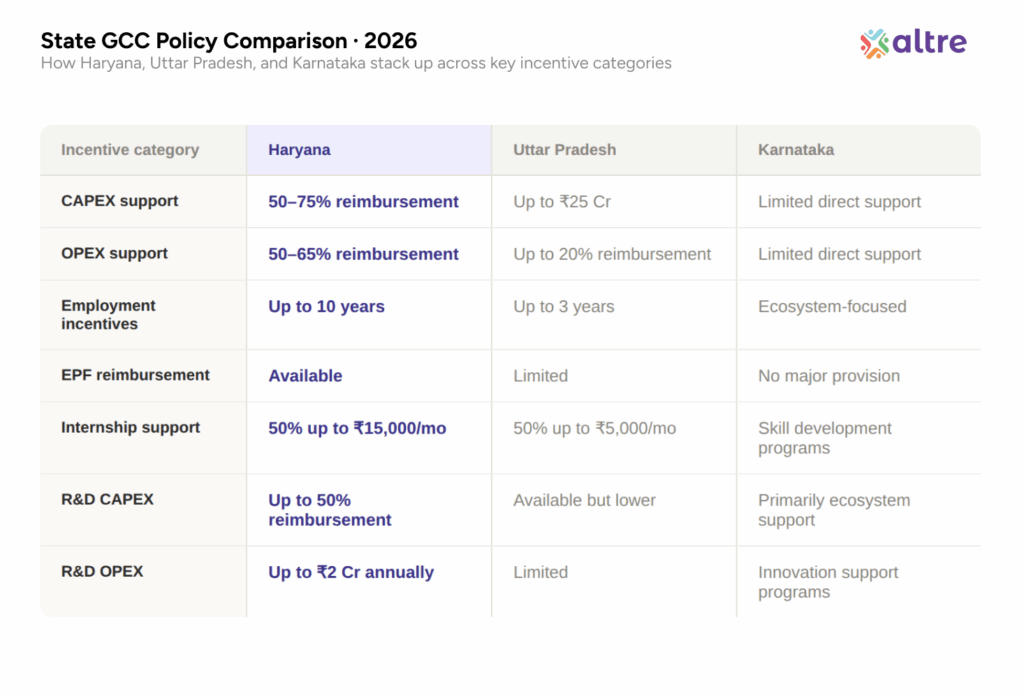
Uttar Pradesh and Karnataka both have meaningful GCC policies, but they are calibrated differently. UP focuses on ecosystem creation and regulatory facilitation. Karnataka is investing in talent development, Centres of Excellence, and innovation infrastructure, defending and extending its position as India's largest GCC market via its KATALYST framework.
Maharashtra's GCC Policy 2025 targets 400 new GCCs and 4 lakh jobs by 2030, with single-window facilitation through the MAITRI/GCC cell and capital and rental support across Mumbai, Pune, Nagpur, and Nashik.
Haryana is filling a different gap: direct, substantial financial support that makes the economics of a GCC setup more predictable and more attractive for occupiers at the moment of the investment decision. These approaches are complementary rather than competing, and together they reflect a maturing state policy landscape that gives occupiers more tools to structure a compelling business case.
To understand the practical impact of this policy, consider a typical 500-seat GCC in a 50,000 sq ft Grade-A facility, a configuration that represents a large share of new GCC setups across the three markets. For current rent benchmarks across these corridors, Altre's India Office Leasing Landscape Q1 2026 report provides micro-market-level data across NCR and Bengaluru.
At prevailing market rents, the headline occupancy economics look like this:
| Market | Annual Rent | Total Annual Occupancy Cost (incl. CAM, utilities, FM) |
| Noida Expressway | INR 3.60 Cr | INR 5.35 Cr |
| Gurugram (GCER) | INR 4.80 Cr | INR 7.00 Cr |
| Bengaluru (Whitefield) | INR 4.20 Cr | INR 6.20 Cr |
Each market reflects its own distinct positioning. Noida offers the lowest headline cost. Bengaluru sits in the middle. Gurugram commands a premium that, historically, has been justified by its ecosystem advantages.
The picture shifts considerably when policy incentives are factored in:
| Metric | Noida | Gurugram | Bengaluru |
| Initial Setup Cost | INR 22.35 Cr | INR 23.35 Cr | INR 24.35 Cr |
| Annual Occupancy Cost | INR 5.35 Cr | INR 7.00 Cr | INR 6.20 Cr |
| Estimated Policy Incentives | INR 8 to 12 Cr | INR 15 to 18 Cr | Limited* |
| Effective Setup Cost After Incentives | INR 10 to 14 Cr | INR 5 to 8 Cr | INR 24+ Cr |
*Karnataka's KATALYST framework offers facilitation and talent incentives; direct CAPEX and OPEX reimbursement on the Haryana scale is not currently available.
What this table illustrates is not a hierarchy of cities but a shift in how the conversation should be framed. Gurugram, which has always offered strong ecosystem value at a premium, now also offers some of the most compelling incentive-adjusted economics of any GCC market in India. Noida's natural cost advantage, meanwhile, remains intact: the Haryana policy simply adds another layer of value to the NCR story as a whole.
For occupiers who were already drawn to the NCR region, the policy strengthens the case for both markets. For those evaluating India's major GCC hubs, it introduces a new financial variable that sits alongside the traditional considerations of talent, infrastructure, and ecosystem maturity.
Gurugram has long been North India's premier GCC address. The concentration of Fortune 500 GCCs, the depth of senior leadership talent, the maturity of professional service providers, and the proximity to major Indian corporate headquarters have created a self-reinforcing ecosystem that draws occupiers despite higher headline costs. Altre tracks coworking and managed office options in Gurugram across Golf Course Extension Road, Cyber City, and DLF Avenue corridors for occupiers evaluating managed versus conventional leasing.
The Haryana GCC Policy is designed to build on this foundation, not replace it. By layering significant financial incentives on top of an already mature market, the policy enables occupiers to access Gurugram's ecosystem advantages without absorbing the full cost premium that has historically come with them.
In practical terms, a 500-seat GCC on Golf Course Extension Road may carry approximately INR 7 crore in annual occupancy costs. Haryana's OPEX reimbursement mechanism can substantially offset a significant portion of this, while CAPEX support lowers initial entry costs further still. The result is that the effective first-year economics of a Gurugram GCC become highly competitive: not by making Gurugram artificially cheap, but by ensuring that occupiers who choose it for the right reasons are not penalised financially for doing so.
For occupiers evaluating Noida alongside Gurugram, Altre also tracks coworking and managed office availability along the Noida Expressway, where corridor-level rent benchmarks and floor plate availability differ materially from the Gurugram market.
The way GCC location decisions are made has evolved. Talent and real estate costs remain the primary filters, but state government policy has become a genuine first-order input in many site selection processes. The combination of incentive programmes, policy certainty, and government engagement capacity is now routinely factored into the financial modelling that underpins investment decisions.
Haryana's GCC Policy 2026 raises the bar in this regard. For occupiers evaluating the NCR region, it shifts the conversation from a simple rental comparison to a more nuanced assessment of total cost after incentives, a framing that opens up options that might previously have been closed on cost grounds alone.
For first-time GCC entrants building an internal business case, the policy provides a credible set of numbers to anchor around. For established multinationals evaluating expansion, it introduces a compelling reason to consider Gurugram not just as the premium option but as the strategically optimal one.
And for the NCR region as a whole, it marks a moment where North India's case for GCC investment has become meaningfully stronger: not by diminishing what any individual city offers, but by ensuring that the region's collective strengths are matched by equally competitive economics.
For a detailed view of micro-market dynamics, incentive modelling, and GCC location strategy across NCR and India's other major markets, explore Altre's Business Location Advisory platform or connect with our advisory team.
What are the main incentives under the Haryana GCC Policy 2026?
The Haryana GCC Policy 2026, notified under the “Make in Haryana” industrial framework, offers up to 75% CAPEX reimbursement on fitout costs, up to 65% OPEX reimbursement on recurring operational costs, employment generation incentives running up to 10 years, EPF reimbursements, internship support at 50% of stipend costs up to INR 15,000 per month, and R&D and innovation incentives including up to 50% CAPEX reimbursement and up to INR 2 crore annually in OPEX support.
How does the Haryana GCC Policy compare with Karnataka and Maharashtra?
Karnataka's KATALYST framework focuses on talent development, Centres of Excellence, and innovation infrastructure. Maharashtra's GCC Policy 2025 offers single-window facilitation and targets 400 new GCCs by 2030. Haryana's approach is more directly financial: substantial CAPEX and OPEX reimbursements that reduce the actual cost of setting up and running a GCC. The approaches are complementary, targeting different parts of the occupier decision.
What does a 500-seat GCC cost in Gurugram vs Noida vs Bengaluru?
At prevailing market rents for a 500-seat GCC in a 50,000 sq ft Grade-A facility, annual occupancy costs including CAM, utilities, and facility management run approximately INR 5.35 crore in Noida, INR 7 crore in Gurugram, and INR 6.2 crore in Bengaluru. When Haryana's policy incentives are factored in, estimated at INR 15 to 18 crore for Gurugram and INR 8 to 12 crore for Noida, the effective setup economics of Gurugram become highly competitive against both alternatives.
Is Gurugram or Noida better for a GCC in NCR?
Both serve different mandates. Noida offers lower headline costs and a strong engineering college pipeline, making it well-suited for cost-sensitive, engineering-heavy operations. Gurugram offers ecosystem maturity, Fortune 500 GCC concentration, and deeper senior leadership talent, at a headline cost premium that Haryana's new policy incentives now substantially offset. For occupiers evaluating a phased India expansion, the NCR region as a whole offers a credible pathway across both dimensions.
When was the Haryana GCC Policy 2026 notified?
The Haryana GCC Policy 2026 was notified as part of the “Make in Haryana” industrial framework, officially launched on June 1, 2026. The policy is valid for five years and targets over 100 new GCCs in the state.
Which states in India have dedicated GCC policies?
As of 2026, states with dedicated GCC or GCC-aligned policies include Karnataka (KATALYST framework), Telangana (single-window GCC facilitation), Maharashtra (GCC Policy 2025), Uttar Pradesh, Gujarat, Andhra Pradesh (IT and GCC Policy 4.0), and now Haryana (GCC Policy 2026 under Make in Haryana). The policies vary significantly in approach, with Haryana's being the most directly financial in its incentive structure.
Published: June 11, 2026
Discover more insights and expert perspectives on commercial real estate and business growth

Copyright © 2026. All rights reserved.